MPPT vs PWM charge controllers — where the extra yield actually comes from
Why a 99.5 % tracker beats a PWM controller on a cold, bright morning, and when the price difference does not pay back.
A PWM controller is, electrically, a switch. When it closes, the panel is dragged down to battery voltage. If the array sits at 36 V at its maximum power point and the battery is at 26 V, the panel is forced to work at 26 V — and the roughly 10 V of difference is simply not harvested.
An MPPT controller is a DC-DC converter with a search algorithm on top. It lets the panel sit at its own optimum, then converts the surplus voltage into extra charge current.
Where the gap is widest
- Cold, bright mornings. Panel open-circuit voltage rises as temperature falls. That is exactly when a PWM controller throws the most away.
- Deeply discharged batteries. The lower the battery voltage, the bigger the mismatch.
- High-voltage strings. Wiring panels in series to reduce cable loss only pays off if the controller can convert the voltage back down.
Where PWM is still defensible
On a small 12 V system with a single 12 V-nominal panel and a warm climate, the array voltage is already close to battery voltage. The mismatch is small, and the price difference will not pay back over the life of the installation.
What our controllers do
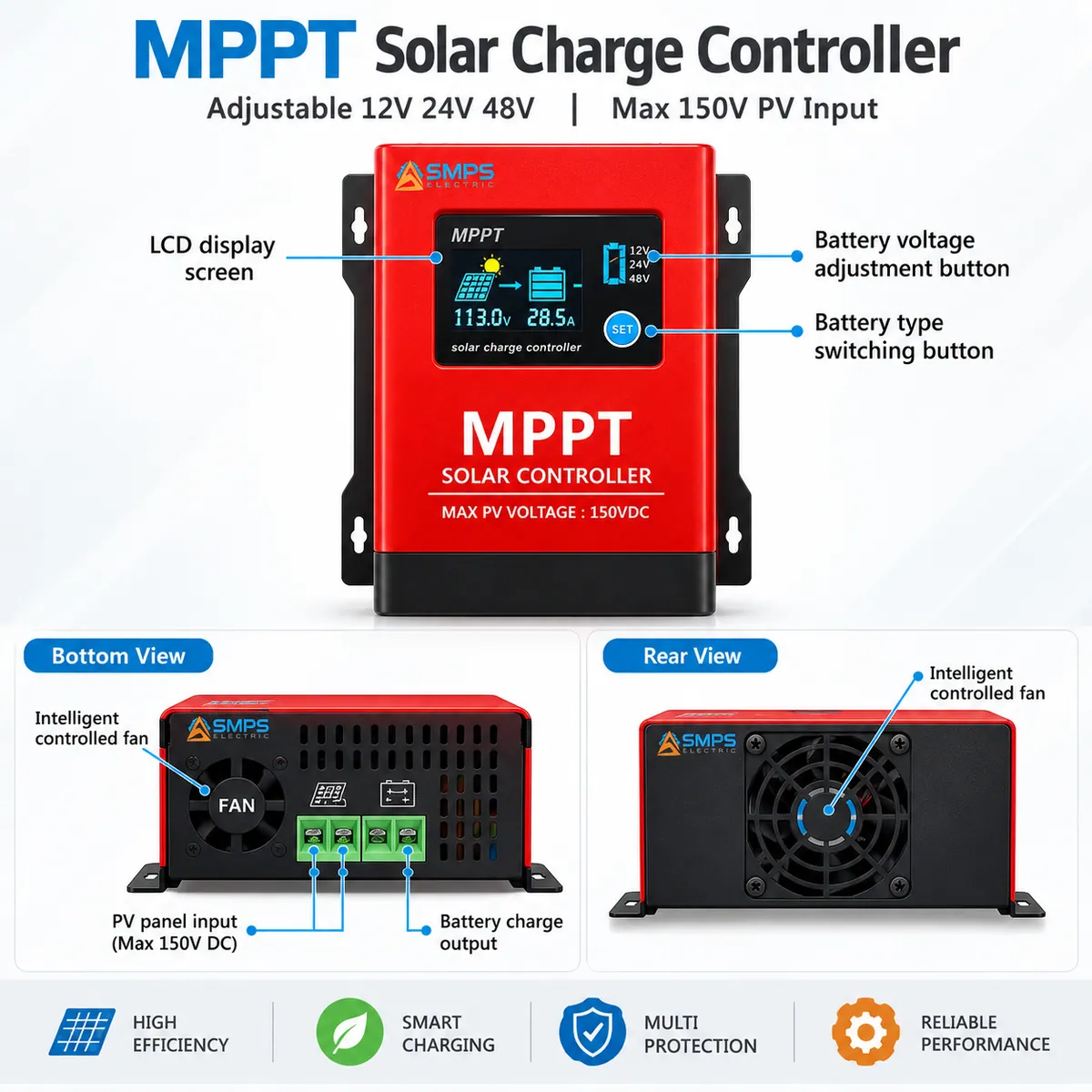
The SMPS MPPT line tracks to about 99.5 %, auto-detects 12, 24, 36 and 48 V battery banks, and handles up to 200 A of charge current at up to 450 Vdc of PV input. Over-voltage, over-current and over-temperature protection are built in, and there is a 5 V USB output for the site's instrumentation.
Sizing rule of thumb
Take the array's short-circuit current, add 25 % for irradiance spikes, and choose a controller rated above that. Then check the PV input voltage window at the coldest temperature the site actually reaches, not the annual average.
Need this applied to your site?
Send the load profile and our engineers will answer with a configuration.
Discuss Your Project