
The engineering behind the spec sheet.
Explainers written by the people who design the hardware, a plain-English glossary of power-electronics terms, and answers to what buyers actually ask us.
MPPT vs PWM charge controllers — where the extra yield actually comes from
Why a 99.5 % tracker beats a PWM controller on a cold, bright morning, and when the price difference does not pay back.
Read article →
CCS2, GB/T and CHAdeMO — choosing a connector set for an Indian fleet
What each standard commits you to on the DC side, and how to avoid a depot that cannot charge half its own vehicles.
Read article →
Why THD below 2 % matters on an industrial DC supply
Ripple is not a cosmetic number. What it does to plating finish, to bath chemistry, and to the life of everything downstream.
Read article →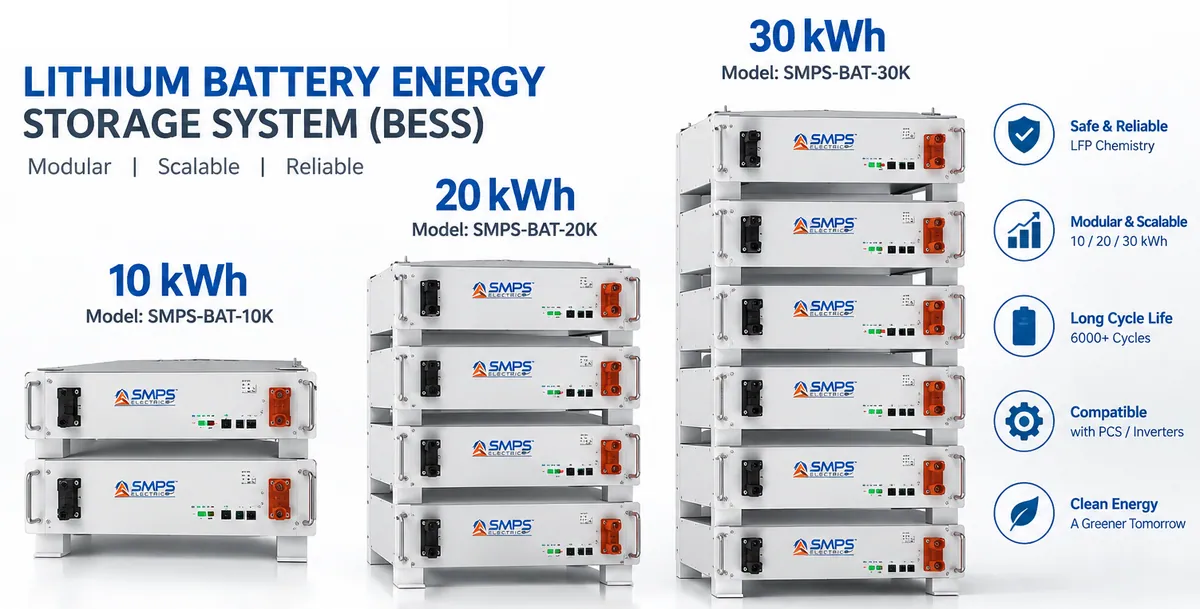
LiFePO4 vs lead-acid for a telecom BTS site
Cycle life, ambient temperature, theft risk and the real total cost of a −48 V plant over eight years.
Read article →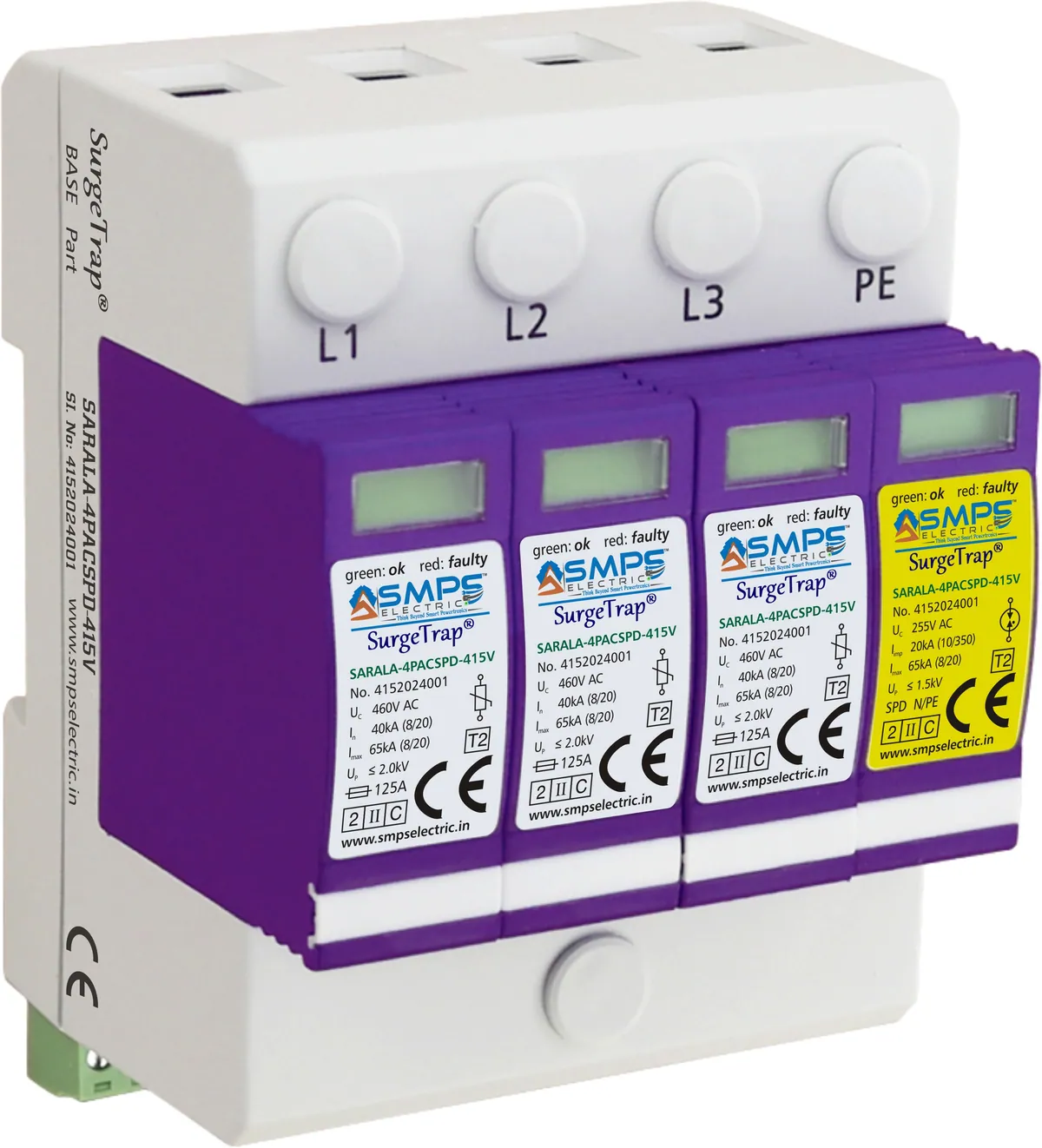
Sizing a Type 2 SPD for a combined solar and EV site
In 40 kA, Imax 65 kA, 255 Vac — what those numbers mean when the strings and the charger share an earth.
Read article →
Split-core AC/DC current sensing, explained without the maths
Why an ordinary CT cannot see DC residual current, and what that means for EV charger safety compliance.
Read article →
Float and boost charging for forklift and e-rickshaw fleets
Getting the crossover point right so a shared charger does not quietly cook one chemistry to suit another.
Read article →
Static vs regenerative electronic loads in production test
One turns your test energy into heat you then pay to remove. The other sends it back to the 230 V line.
Read article →Total Harmonic Distortion — how far a waveform departs from a clean sine. Our industrial DC supplies hold below 2 %.
Constant Current then Constant Voltage. The supply pushes a fixed current until the target voltage is reached, then holds voltage and lets current fall away.
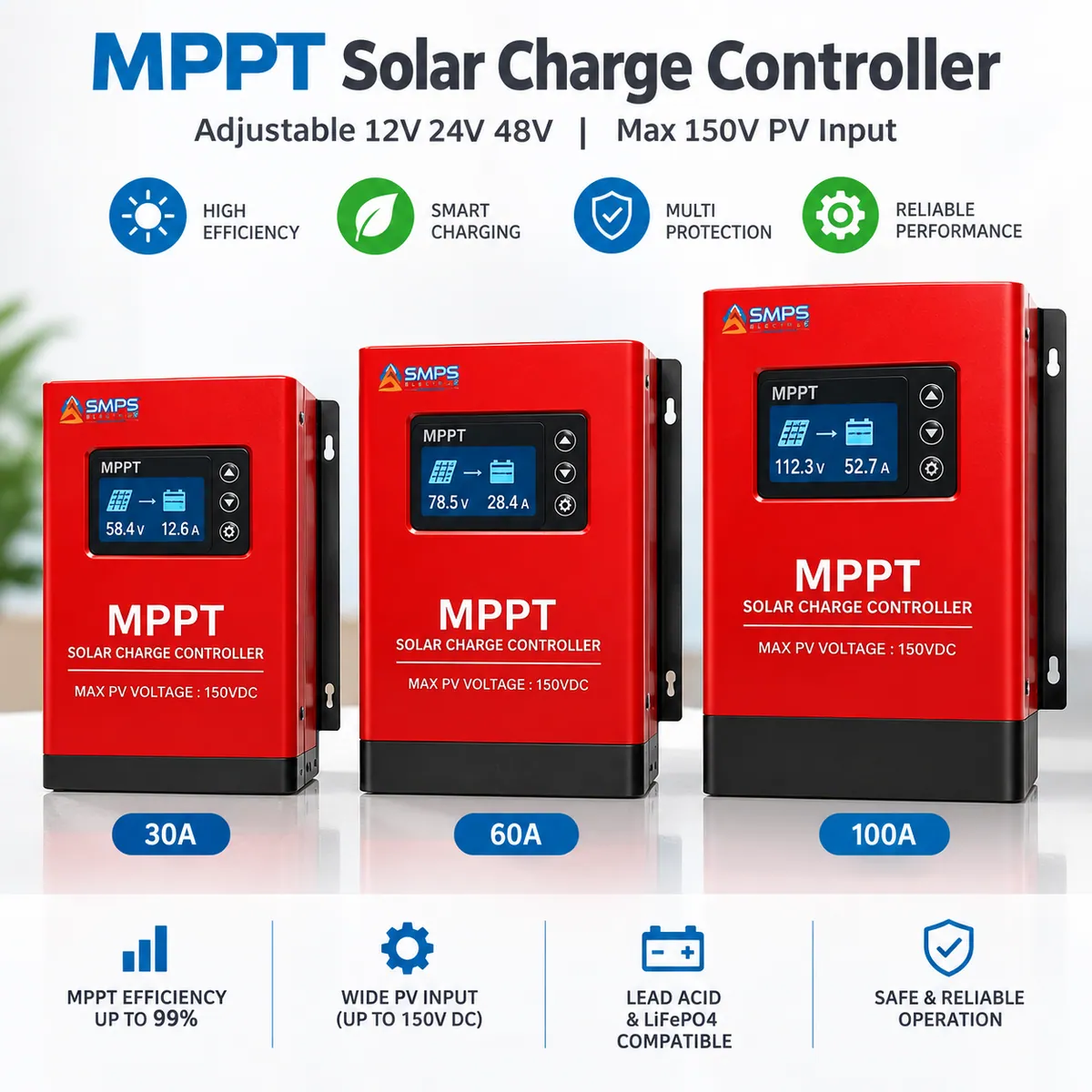
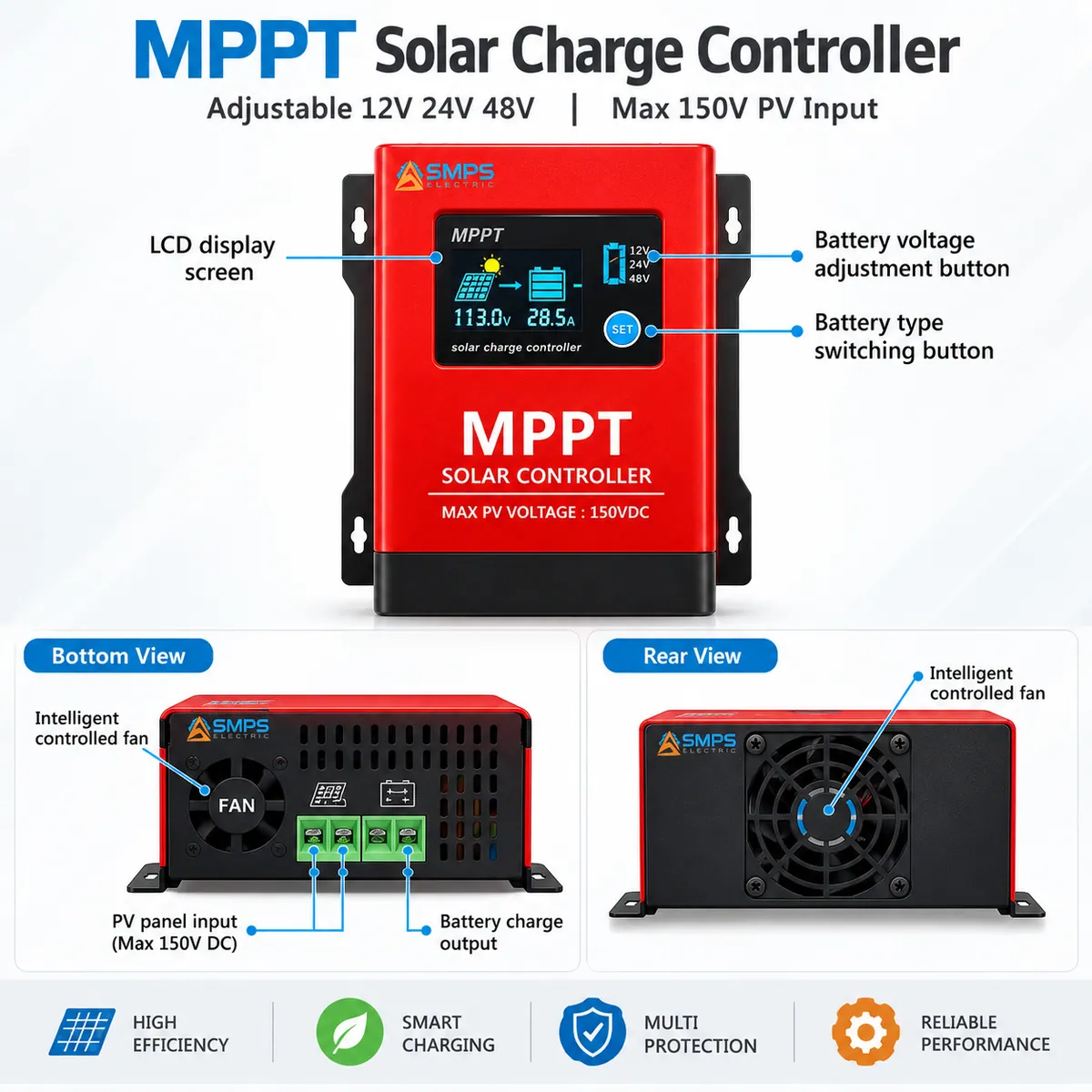
Maximum Power Point Tracking — continuously finding the voltage at which a PV string delivers the most power. Ours tracks to about 99.5 %.
Combined Charging System Type 2 — the European DC fast-charge connector, widely adopted on Indian four-wheelers.
The Chinese charging standard, common on imported two- and three-wheelers and on some bus fleets.
The Japanese DC fast-charge standard. Still required wherever older imported vehicles are in service.
Valve-Regulated Lead-Acid — sealed lead-acid that needs no water top-up but is unforgiving about overcharge.
Battery Management System — cell balancing, temperature limits and state-of-charge reporting. Built into our LiFePO4 packs.
A surge protective device for distribution boards, clamping switching and induced lightning surges. Rated by In (nominal) and Imax (maximum) discharge current.
A current transformer that opens on a hinge so it can be clipped around a live conductor without breaking the circuit.
Scalar (V/f) control holds a voltage-to-frequency ratio. Vector control models the motor to hold torque accurately at low speed.
Float holds a battery topped up indefinitely; boost applies a higher voltage to recharge quickly. Getting the crossover wrong shortens battery life.
An electronic load that returns absorbed energy to the AC line instead of dissipating it as heat.
A single-building or single-site power island that can run connected to the grid or independently of it.
Printed Circuit Board Assembly — populating a bare board with components, the step between PCB fabrication and a working unit.
Industrial Internet of Things — instrumenting industrial equipment so it reports state and can be supervised remotely.
What customers ask before ordering.
Question not answered here?
Send the site details and engineering will reply with a specification.
Ask engineeringLead time depends on the line and configuration. Standard MPPT, inverter and AC pedestal units ship from stock configurations; DC fast cabinets and custom industrial DC are built to order after design sign-off.
It shifts load between PV, battery and grid by priority. The saving depends on your tariff, your load curve and the array size — which is why we ask for a load profile before quoting.
Yes. The solar hybrid line supports up to nine units in parallel, with PV, battery and grid priority configurable and a no-battery mode for grid-tied sites.
Air-cooled units need filter and fan checks on a schedule set by ambient dust. Battery packs report state of health over RS232/RS485. SPD cartridges are inspected after any significant surge event.
For DC fast installations, yes — incoming supply capacity, earthing and cable runs all change the specification. AC pedestals are usually straightforward on an existing three-phase board.
Yes. BIS, ISO, TEC and CE documentation is available per line, and defence builds carry altitude, vibration and seismic qualification.
Want a topic covered?
Tell us what your team keeps getting wrong about power electronics and we will write it up.